
From writing code I don’t fully understand, to validating business ideas at midnight – this is the honest, unfiltered version of my Daily AI workflow.
Let me start with an embarrassing confession.

About two years ago, someone asked me if I used Artificial Intelligence in my work. And I said, “Yeah, sometimes – for like captions and stuff.”
That was it. That was the extent of it. I was treating AI like a fancy autocomplete. A shortcut for the lazy moments. Something to help me when I get stuck on a headline.
Fast forward to today, and AI is woven into almost everything I do. Coding, content creation, client strategy, business validation – it touches all of it. Not because I forced it in, but because once I started genuinely experimenting, I couldn’t imagine going back.
This isn’t a post about Artificial Intelligence hype. I’m not going to sell you on some magical future. I want to tell you exactly what I actually do, how it actually works, and what’s changed for me since I stopped treating AI like a toy and started treating it like a thinking partner.
First, let’s talk about the mindset shift that changed everything
Most people use AI reactively. Something’s hard, they paste it in, they get an answer, they move on. That’s fine – that’s useful – but it barely scratches the surface.
The shift for me happened when I started using AI proactively. Not just “help me with this task” but “help me think through this problem.” Not just “write this for me” but “here’s my rough thinking – help me make it sharper.”
That’s a totally different relationship with the tool. And once you start having that relationship, you realise how much cognitive load you were carrying around for no reason.
“I didn’t stop thinking. I just stopped wasting energy on the parts that don’t require my specific brain.”
With that framing in place, here’s how that actually plays out across four different areas of my work.
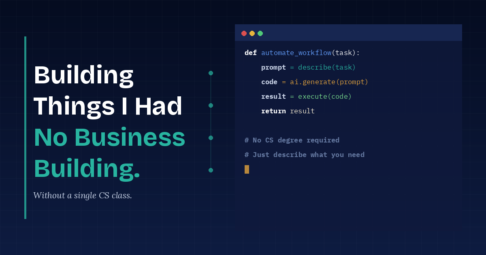
1. Daily AI Workflow for Coding – building things I had no business building
Okay, full transparency: I am not a developer. I never formally learned to code. I can read code reasonably well now, but there was a time when even a simple Python script felt like reading a foreign language.
And yet, in the last year, I’ve built automation workflows, set up API connections, customised my WordPress site in ways I’d previously have paid someone else to handle, and created small tools that genuinely save me hours every week.
How? By describing exactly what I want in plain English and letting AI write the first version of the code.
I’ll be honest about what this looks like in practice. I’ll say something like: “I want a script that pulls data from this spreadsheet, filters rows where the status column says ‘pending’, and sends me a summary email every morning.” And I get working code. Not perfect code. Not always the most elegant code. But working code that I can understand well enough to troubleshoot and tweak.
That’s the part people miss. Artificial Intelligence didn’t make me a developer. It made me capable enough to have a productive conversation with my own codebase. I know what questions to ask when something breaks. I know how to describe what I want more precisely each time. The skill I’ve actually built is learning how to communicate technical ideas clearly – and that turns out to be genuinely useful.
WHAT THIS LOOKS LIKE DAY-TO-DAY: I’ll hit a problem, describe it conversationally, get a solution, test it, hit another problem, describe that, iterate. It feels less like programming and more like collaborating with a very patient technical co-founder who never judges you for not knowing what a for-loop is.
The bigger unlock here is speed. Things that would have taken me three days of YouTube tutorials and Stack Overflow rabbit holes now take an afternoon. That time doesn’t disappear – it goes back into the work that actually matters.
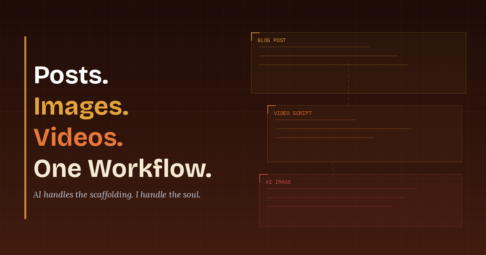
2. AI Workflow for Content creation – posts, images, and videos, all in one workflow
This is probably the area where most people are using Artificial Intelligence, but I think most people are using it badly. So let me tell you what actually works for me.
For written content – blog posts, YouTube scripts, LinkedIn pieces, email newsletters – I never ask AI to “write a post about X.” That produces something that sounds like every other AI-generated article you’ve ever read: technically fine, deeply forgettable.
What I do instead is voice-note or type out my raw thoughts. The messy, half-formed, slightly rambly version of whatever’s in my head. Then I paste that into a prompt and say: “Here’s my rough thinking. Help me find the structure. What’s the actual argument I’m making?”
That back-and-forth is where the magic is. AI helps me find the thread I was actually trying to pull on. Then I write – in my own voice, with my own examples, from my own experience. The article you’re reading right now went through a version of that process.
For images, I’ve built AI into my standard content workflow. I use image generation tools when I need custom visuals – featured images for blog posts, thumbnails, social graphics, illustrations for concepts I want to explain visually. The key is being specific in your prompts. The difference between “a person using a laptop” and “a person at a minimalist wooden desk, warm afternoon light, slightly overhead angle, editorial style, muted palette” is the difference between generic stock art and something that actually feels intentional.
For video, AI helps me at the scripting and structure stage. Before I ever turn the camera on, I’ve usually had a conversation with AI about the hook, the flow, where the transitions should be, and what examples to use. By the time I sit down to record, I’m not figuring things out – I’m delivering something I’ve already thought through. The recording gets done in fewer takes. The editing is simpler because the structure was right from the start.
“Artificial Intelligence handles the scaffolding. I handle the soul. That balance is what makes the content actually good.”
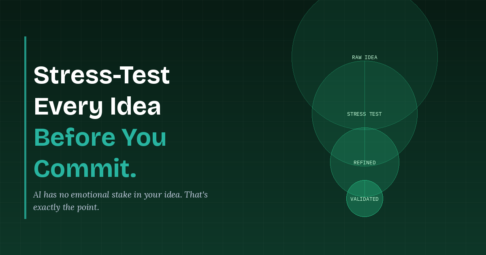
3. AI Workflow for Validating Business Ideas – before I waste a single rupee
This one is my personal favourite, and it’s the use case I talk about least, even though it might be the most valuable thing AI does for me.
Here’s the old version of idea validation: spend a few days researching, find some vague data that supports whatever you already want to believe, convince yourself the idea is solid, and dive in. Most of us have lost time and money this way. I certainly have.
Now I have a different process. When I have a new business idea – for myself or for a client – I run it through a structured AI conversation before I invest anything real into it.
I’ll describe the idea, the target audience, the business model, and the problem I think it’s solving. And then – this is the important part – I’ll ask AI to push back. Hard.
“What are the weakest parts of this idea? Who’s already doing this and doing it well? What would a skeptical investor say? What am I probably underestimating? What would have to be true for this to fail?”
AI is genuinely good at this kind of adversarial thinking because it has no emotional stake in your idea. It doesn’t care that you’ve been excited about this for three weeks. It’ll tell you, plainly, that the market is smaller than you think, that there are three well-funded competitors doing exactly this, and that the customer acquisition cost in this niche tends to be brutal. That’s uncomfortable. It’s also incredibly useful.
A REAL EXAMPLE: I had an idea for a productised service targeting a specific niche. I was excited. I spent about 45 minutes in an AI conversation stress-testing every assumption; some assumptions held up, and some didn’t. Then I adjusted the positioning before I built anything. The version I ended up with was sharper, more specific, and had a clearer path to revenue – all before I spent a day on it.
Some ideas survive this process stronger. Some don’t survive at all – and that’s equally valuable, because the worst thing you can do is spend six months building something the market doesn’t want.
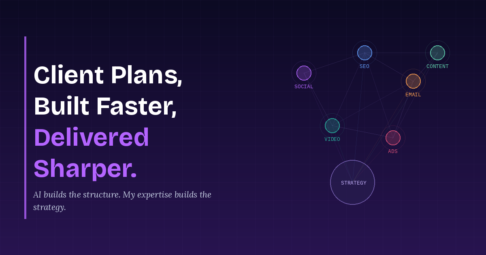
4. Digital marketing plans for clients – strategy faster, delivered better
When a client comes to me for a marketing strategy, they’re paying for my judgment, my experience, and my understanding of their business. That’s the thing I bring. The hours of research, the document formatting, the gathering of information – that’s not what they’re paying for.
AI has let me separate those two things in a way that’s made me genuinely better at my job.
Here’s the process: I’ll give AI a detailed brief about the client – their industry, their target customer, their current marketing position, their goals, their budget range, what’s worked and what hasn’t. Then I’ll ask it to give me a framework: which channels make sense for this profile, what content angles tend to perform in this niche, and what a 90-day plan might look like.
What comes back is a solid starting point. Not the final plan – the starting point. From there, I bring in everything AI can’t know. I know the Indian digital marketing landscape in ways a general model doesn’t. I know which platforms actually convert for this type of client in this city. I know what this specific business owner will actually execute, because I’ve spoken to them, and I understand their capacity and their comfort zone.
That last layer – the one that requires a real human who understands the context – is where the value is. AI gives me the structure. I give it the substance that makes it real.
The result is that I can deliver more thorough, better-researched plans in less time. And the time I save isn’t wasted – it goes into more conversations with the client, more refinement, more follow-through.
What I’ve actually learned from all of this
The biggest lesson isn’t about any specific tool or any specific use case. It’s about what AI actually is and isn’t.
AI is not going to replace your thinking. It’s going to expose whether you have any. If you use it to skip the thinking, the output will be shallow. If you use it to extend your thinking – to pressure-test it, to structure it, to accelerate the parts that don’t require your specific perspective – the output will be something you’re actually proud of.
I’ve also learned that the quality of what you get out is almost entirely a function of what you put in. Vague prompts get vague answers. When I write a detailed, specific, context-rich prompt – one that explains the goal, the audience, the constraints, and what I’ve already tried – I get something I can actually use in about two minutes. That skill of communicating clearly and precisely with AI is, I’d argue, the most important thing to develop right now.
And finally – and I say this as someone who is genuinely enthusiastic about this stuff – AI doesn’t replace the relationships, the judgment calls, or the things that require actually being a person who’s been around for a while. Those things matter more now, not less, because everyone has access to the same tools. The differentiator is how well you use them, and what you bring that the tool never will.
“The busywork is gone. What’s left is the work that actually matters – and there’s more of it than ever.”
If you’re not already experimenting with AI this way, pick one of these four areas and start there this week. Not to replace what you do – to find out where your time is going, so that it doesn’t need to.
You might be surprised how much of it there is.
Me, The Author: Rohit Katke (LinkedIn)
Do reach out to me if you want to discuss and bounce some ideas, and validate them with my experience so far with AI. I’d love to hear what you’re working on.
In case you want to connect with the FreelanceEducator.com Team, then get in touch.